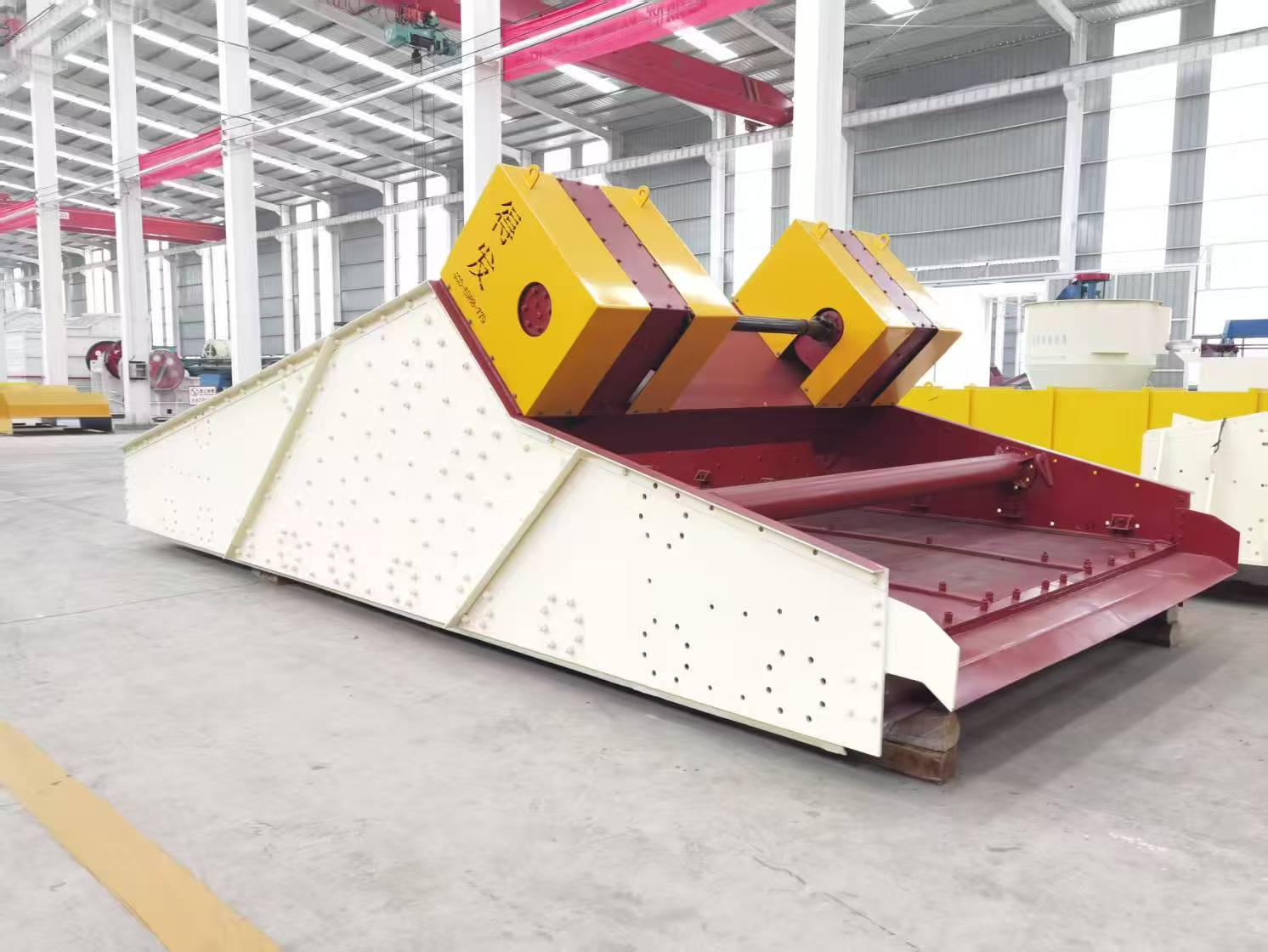
1. Product Overview
Linear dewatering screen is a kind of high-efficiency screening and dewatering equipment widely used in mining, coal, electric power, metallurgy, building materials, chemical industry and other industries. Its main function is to screen the water-containing materials with high frequency vibration, quickly remove the surface moisture, realize the dry-wet separation and preliminary dehydration of the materials, and is suitable for the process of de-mediation, dehydration, desludging, etc. The equipment plays an irreplaceable and important role in the modern solid-liquid separation process with its compact structure, stable operation, high screening efficiency and low energy consumption.
2. Working Principle
The linear dewatering screen mainly relies on the exciting force generated by two synchronous vibration motors in the same direction to transport the material forward on the screen surface in a parabolic motion trajectory, and achieve stratification and dehydration in the process. When the material is fed into the screen surface, it quickly diffuses and separates under the action of the exciting force, and the water seeps through the screen, and the solid particles quickly move to the discharge end under vibration to achieve the purpose of dehydration.
The equipment mainly adopts the principle of high-frequency linear vibration. Compared with traditional circular vibration screens or drum screens, it has higher dehydration efficiency and less water under the screen. It is particularly suitable for processing medium and fine particles or slurry materials.
3. Structural composition
The core components of the linear dewatering screen include the following:
1. Screen box (screen body)
The screen box is the main part of the equipment, usually made of welded steel plates, with a solid and reliable structure that can withstand high-frequency vibration loads. It is equipped with a screen inside and is the core area for material screening.
2. Screen
The screen is made of high-strength polyurethane or stainless steel, which has the advantages of strong wear resistance, good water permeability, and not easy to block holes. According to different material and process requirements, screens with different apertures and structures can be selected (such as slit screens, woven meshes, perforated plates, etc.).
3. Vibration motor
The linear dewatering screen is usually equipped with two vibration motors of the same model and specification, which are installed on both sides or the bottom of the screen body, and use the self-synchronization principle to generate linear exciting force. The motor has an adjustable eccentric block design, which is convenient for adjusting the exciting force, thereby controlling the screening efficiency and dewatering rate.
4. Shock absorber
The bottom of the screen body is equipped with rubber springs or composite springs as a support and shock absorption system, which can effectively absorb vibration, extend the life of the equipment and reduce the foundation load.
5. Water outlet and material outlet
There is a water collecting bucket and drainage channel under the screen to collect and discharge the water under the screen; there is a discharge port at the tail of the screen to centrally transport the materials on the screen.
4. Technical Features
1. High frequency and low amplitude design
By optimizing the motor parameters and screen structure, high-frequency vibration (25-50Hz) and low amplitude are combined to greatly improve the dehydration efficiency while reducing the loss of fine particles.
2. The inclination angle of the screen surface is adjustable
The inclination angle of the screen surface is usually between -3° and 5°, and can be adjusted according to different material properties and processing requirements, taking into account both material flow rate and dewatering depth.
3. High openness screen
The screen adopts a high opening rate design with a special drainage structure to increase the liquid penetration rate, prevent particle blockage, and improve screening processing capacity.
4. Self-cleaning structure
The screen surface is reasonably designed, the material is easy to roll under high-frequency vibration, and the screen holes are not easy to be blocked; some models are equipped with a water spray device for online cleaning of the screen surface.
5. Low noise and low energy consumption
The equipment operation noise is controlled below 85 decibels, the vibration motor power is reasonably matched, and the overall energy consumption is reduced by 15%-30% compared with traditional dehydration equipment.
5. Performance advantages
1. High dehydration efficiency
The moisture content of the final product on the linear dewatering screen can be controlled between 10% and 15%. Some models can even achieve low moisture discharge of 8% to 10%, significantly improving downstream process efficiency.
2. Strong processing capability
The processing capacity of a single device can reach 30-200 tons/hour, which can adapt to large-scale continuous operations and meet the needs of medium and large-scale mineral processing or sand washing systems.
3. Fine screening particle size
It is suitable for screening and separation of fine-grained materials larger than 0.1mm, and is particularly suitable for tailings dry discharge, coal slime dehydration, sand and gravel washing, etc.
4. Long service life
The screen body has a compact structure, and key components are made of high-strength alloy, rubber and polyurethane materials, which are corrosion-resistant, fatigue-resistant and have a long maintenance-free cycle.
5. Adaptability
It is not only suitable for conventional mineral processing processes, but can also be promoted and applied in industries such as chemical, pharmaceutical, environmental protection, and municipal sludge treatment, and is adaptable to a variety of material forms such as slurry, mud, and powder.
6. Application fields
1. Mining industry
It is used for dehydration of tailings from metal and non-metallic minerals, dehydration of flotation concentrates, recovery of under-screen fine mud, and other processes to increase slurry concentration and resource recovery rate.
2. Sand washing industry
It is widely used in the cleaning and dehydration process of machine-made sand and natural sand. When used in conjunction with fine sand recovery equipment, it can effectively reduce the moisture content of finished sand and improve stacking and transportation efficiency.
3. Coal Industry
It is used for dehydration of coal slurry, screening of gangue on screen, coal de-mediuming and dehydration to improve fuel purity and calorific value.
4. Chemical Industry and Environmental Protection
It is suitable for solid-liquid separation of slurry in salt, potash fertilizer, dye, starch, papermaking and other industries. It can also be used as pre-screening equipment in municipal sludge dewatering and industrial wastewater treatment.
5. Building materials industry
It is used for screening and dehydration of building materials such as quartz sand, ceramic clay, kaolin, etc., to ensure the stability of subsequent drying, sintering and other processes.
7. Selection parameter reference
| model | Screen surface size (mm) | Power (kW) | Processing capacity (t/h) | Moisture content (%) | Weight (kg) |
|---|---|---|---|---|---|
| ZD-1230 | 1200×3000 | 2×1.5 | 30-50 | 10-15 | 2800 |
| ZD-1536 | 1500×3600 | 2×2.2 | 50-80 | 10-14 | 3600 |
| ZD-1845 | 1800×4500 | 2×3.0 | 80-120 | 9-12 | 5200 |
| ZD-2160 | 2100×6000 | 2×4.0 | 120-200 | 8-10 | 7800 |
Note: The parameters are for reference only and need to be determined based on the material properties, moisture content and on-site process requirements.
8. Key points for use and maintenance
1. Installation precautions
The equipment should be installed horizontally to ensure that the vibration direction is straight.
The vibration motor angles must be symmetrical and consistent to prevent trajectory deviation.
The shock-absorbing springs should be installed symmetrically to avoid uneven vibration.
2. Daily operation management
Check the tension of the motor cable and screen before starting the machine.
Start with no-load, and feed after it runs smoothly; stop feeding before shutting down.
Check the motor temperature rise and bearing lubrication condition every shift.
3. Screen maintenance and replacement
Check the screen wear regularly and replace it if necessary.
Clean the accumulated material in the sieve holes to prevent blockage and affect efficiency.
Use special tools for disassembly and assembly to prevent damage to the screen surface structure.
4. Other maintenance
Check the motor every three months to see if the fastening bolts are loose.
Replace the motor bearing grease every six months.
Check and clean the drain pipes to keep them unobstructed.
IX. Common Problems and Solutions
| question | reason | Solution |
|---|---|---|
| Screening efficiency decreases | The screen is blocked or damaged | Replace the screen and clean up the accumulated material |
| Abnormal vibration or deviation | The motor is not synchronized and the shock absorbing spring is deformed | Check the motor and adjust the spring |
| Poor material discharge | The inclination angle is too small or the screen aperture is unreasonable | Adjust the screen angle or replace the screen |
| Incomplete water removal | Low feed concentration or fast flow rate | Control feed concentration and speed |
10. Conclusion
As an efficient and energy-saving solid-liquid separation equipment, the linear dewatering screen plays an indispensable role in many industries such as mining, sandstone, coal, and environmental protection with its advanced design concept and excellent process performance. It not only improves production efficiency and optimizes material quality, but also helps enterprises achieve green, automated, and continuous modern production goals. In the future, with the improvement of environmental protection standards and the iteration of process technology, the technical boundaries and application areas of the linear dewatering screen will be further expanded.

About Us
Group Overview
Development History
Corporate Culture
Corporate Honors
Corporate Team
Merchant services
Merchant services
Advertising services
Merchant services
News Center
Group Dynamics
Media Reports
Corporate Videos
Notices and Announcements
Contact Business
Business Cooperation
Join Us
Follow Us
Complaints and Suggestions
Follow the official account