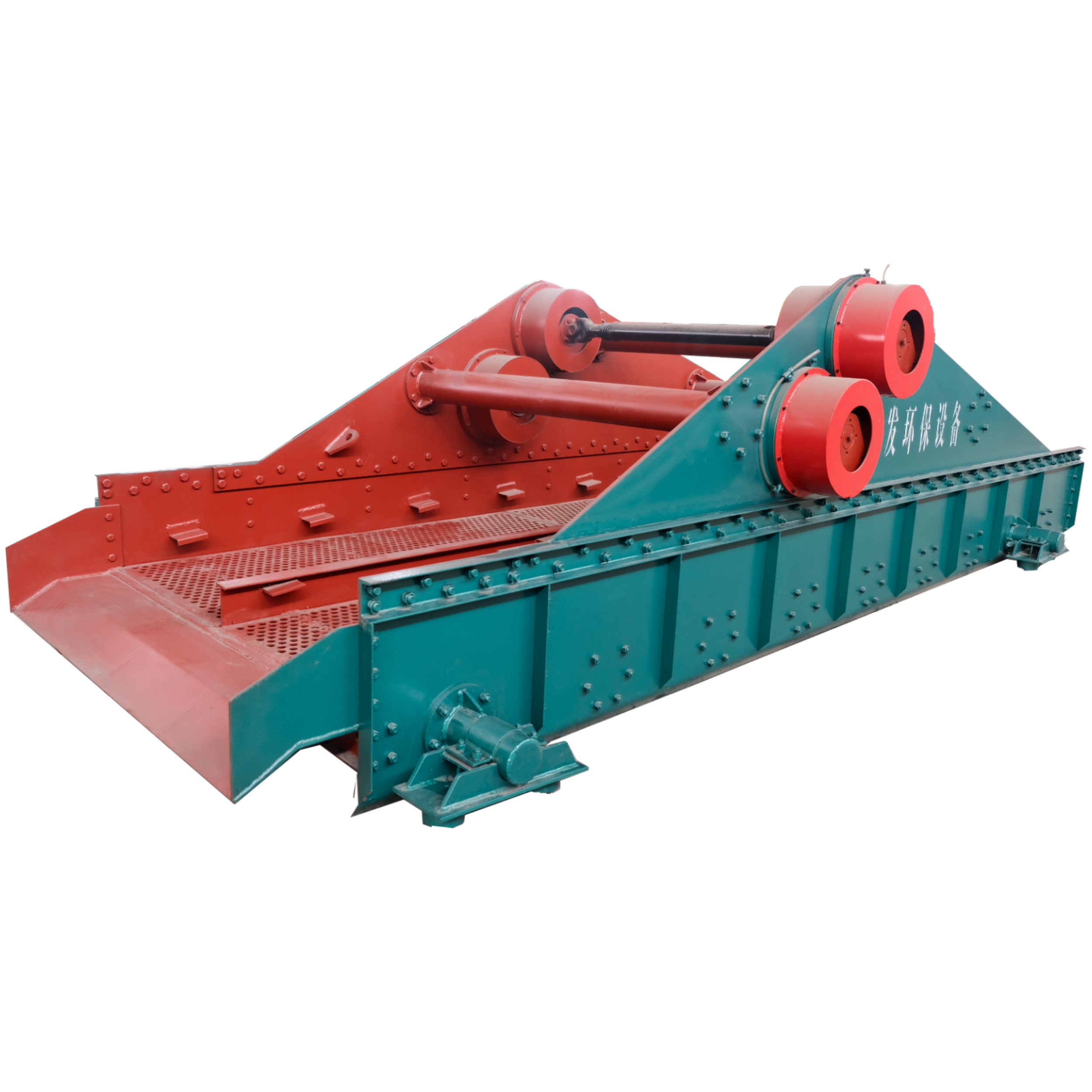
1. Vibration principle and mechanical structure analysis
1. Biaxial excitation principle
The linear vibrating screen is driven by a dual-axis inertial exciter, which generates periodic centrifugal force through two sets of eccentric blocks rotating in opposite directions. This composite exciting force forms a specific vibration trajectory at the center of mass of the screen box, and its motion characteristics are determined by the following key parameters:
Vibration direction angle: Change the material ejection angle by adjusting the phase angle of the eccentric block
Amplitude double-amplitude adjustment: Variable eccentric mass moment design enables infinite amplitude adjustment
Frequency coordination control: Dual motor synchronous drive ensures vibration stability
(II) Screen box structure innovation
Modular screen frame
Detachable structure connected by high-strength bolts
Supports quick replacement of screens of different specifications
The frame material is Q345B low alloy steel
Elastic support system
Polymer composite springs replace traditional metal springs
Adjustable support angle (30°-60°)
Built-in damping device reduces the risk of resonance
Screen surface optimization
Multi-stage screen combination (2-5 stages)
Customized mesh shape (square hole/round hole/long hole)
Screen tensioning mechanism ensures effective contact
(III) Transmission system architecture
Powertrain Configuration
Dual motor independent drive (power range 7.5-55kW)
Frequency conversion speed control (frequency range 5-50Hz)
Flexible couplings compensate for installation errors
Lubrication system
Centralized lubrication device
Oil distributor ensures even lubrication
Oil level monitoring and early warning function
Security protection
Overload protection device (shear pin/friction plate)
Temperature Monitoring Sensors
Vibration monitoring module
2. Design advantages and technical features
1. High-efficiency screening performance
Material adaptability
Grain size range: 0-400mm
Allowable humidity value: ≤8%
Density adaptation: 0.5-3.5t/m³
Kinematic Optimization
Material ejection trajectory calculation software
Screen surface utilization increased by 20%
Optimization of mathematical model of sieve penetration probability
Multi-layer grading
Support 2-5 layers of screen configuration
Independent discharge port design
Classification accuracy ≥95%
(II) Energy-saving and noise-reduction design
Energy Utilization
Vibration energy directional transmission technology
Screen box vibration reduction design reduces energy loss
Motor power factor ≥ 0.85
Noise Control
Multi-stage vibration reduction support system
Screen box closed structure
Noise value ≤85dB(A)
Environmental characteristics
Fully enclosed design prevents dust from escaping
Optional dust removal interface
Comply with GB12348 industrial noise standard
(III) Intelligent control function
Automation
PLC control system (support Modbus protocol)
Touch screen human-machine interface (7-10 inches)
Remote monitoring interface
Condition Monitoring
Real-time monitoring of vibration parameters
Temperature warning system
Intelligent assessment of lubrication status
Troubleshooting
Expert system fault diagnosis
Historical data retrospective analysis
Predictive maintenance recommendations
3. Application scenarios and process integration
1. Application in coal industry
Raw coal screening
Removal of waste rock impurities
Wide particle size range
Improve washing efficiency
Clean coal dehydration and demediation
Use with dehydration equipment
Recycling Magnetite Powder
Reduce dielectric loss
Coal slime recovery
Fine material recovery
Improve resource utilization
Reduce environmental pollution
(II) Application in metallurgical industry
Sinter screening
Removal of unsintered matter
Control the particle size of finished products
Improve the permeability of blast furnace
Pellet classification
Optimize particle size composition
Improve restore performance
Reduce coke consumption
Scrap steel processing
Separation of impurities
Improving scrap purity
Protecting smelting equipment
(III) Application in chemical industry
Catalyst screening
Controlling catalyst particle size
Improve reaction efficiency
Extend service life
Resin particle classification
Separation of rejected particles
Ensure product uniformity
Improve processing performance
Fertilizer production
Raw material screening pretreatment
Finished product particle size control
Improve packaging efficiency
(IV) Application in environmental protection industry
Garbage sorting
Separation of organic/inorganic matter
Improve recycling rates
Reduce landfill
Sludge dewatering
Use with dehydration equipment
Improve dehydration efficiency
Reduce moisture content
Waste plastic recycling
Separating different materials
Improve regeneration quality
Promoting resource circulation
4. Equipment maintenance and management
(I) Daily maintenance specifications
Daily Check
Screen tension
Vibrator operating status
Lubrication system oil level
Weekly Maintenance
Cleaning the inside of the screen box
Check the fastening bolts
Testing safety devices
Monthly maintenance
Replace lubricating oil
Checking screen wear
Calibrating the sensor
(II) Common troubleshooting
Broken screen
Check screen tension
Replacement of worn parts
Adjust feeding method
Vibrator overheating
Check the lubrication system
Clean the air ducts
Replace damaged bearings
Poor discharge
Check for screen blockage
Adjust vibration parameters
Clean the discharge port
(III) Upgrading and transformation plan
Smart Upgrade
Add IoT module
Integrated AI diagnostic system
Implementing predictive maintenance
Performance Improvements
Optimize screen structure
Modification of vibration exciter
Add frequency conversion control
Environmental protection transformation
Integrated dust removal system
Increased noise control
Modification of sealing structure
5. Industry value and development trend
1. Improved production efficiency
By optimizing the screening process, the processing volume per unit time can be increased. In the continuous production system, the linear vibrating screen is a key grading equipment, and its stable operation directly affects the overall production efficiency. The modular design shortens the equipment maintenance time and indirectly improves the availability of the production line.
2. Quality control optimization
In processes that require precise particle size control, the grading accuracy of the linear vibrating screen directly affects the quality of the final product. Through the intelligent control system, fine adjustment of screening parameters can be achieved to meet the particle size requirements of different products.
3. Promotion of industrial upgrading
With the acceleration of the process of industrial intelligence, linear vibrating screen, as a representative of traditional screening equipment, is evolving towards intelligence and automation. By integrating technologies such as the Internet of Things and big data, linear vibrating screen is becoming an important supporting equipment for industrial upgrading.
4. Contribution of Green Manufacturing
By optimizing the screening process, energy waste and material loss can be reduced. The integrated environmental protection function module can reduce dust emission and noise pollution, which is in line with the development trend of green manufacturing. In the circular economy model, linear vibrating screens play an important role in the field of waste material recycling.
VI. Conclusion: A precise interpreter of industrial rhythm
As the core equipment in the field of material classification, the linear vibrating screen has developed into a modern industrial equipment integrating precision machinery, intelligent control and environmental protection technology through continuous optimization and innovation. Its unique dual-axis excitation principle enables it to show irreplaceable advantages in process systems that require fine classification. With the continuous advancement of industrial technology, the linear vibrating screen is developing in the direction of higher efficiency, stronger intelligence and more environmental protection, and continues to provide solid technical support for the transformation and upgrading of industries such as coal, metallurgy and chemical industry. For modern enterprises that pursue production refinement and product quality, choosing an efficient and reliable linear vibrating screen is to choose the precise rhyme of the production process, which is an important basic guarantee for the realization of intelligent manufacturing.

About Us
Group Overview
Development History
Corporate Culture
Corporate Honors
Corporate Team
Merchant services
Merchant services
Advertising services
Merchant services
News Center
Group Dynamics
Media Reports
Corporate Videos
Notices and Announcements
Contact Business
Business Cooperation
Join Us
Follow Us
Complaints and Suggestions
Follow the official account